Chapter 4 — Combination
As coherence strengthened across the lattice, neighboring Coherent Phase Packets (CPPs) began forming temporary associations through their curvature envelopes and phase relationships. Association alone did not establish a stable particle. A configuration could persist, acquire additional CPPs, reorganize, or separate without reaching terminal Region closure.
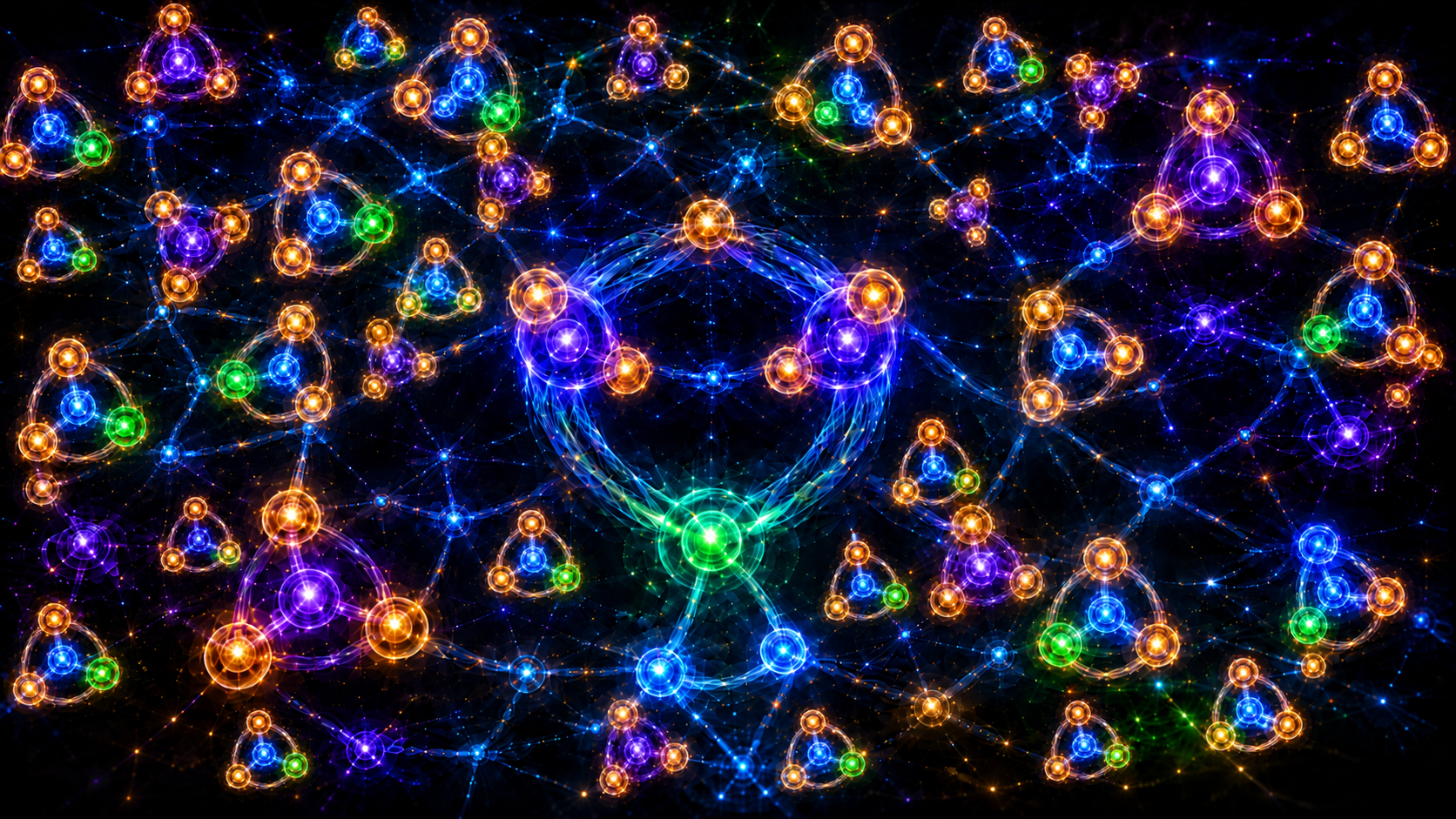
Combination began when a compatible phase structure could return its curvature through a repeating path rather than disperse it into the surrounding lattice. Repetition gave the structure persistence. A circulating pattern that survived successive recurrences became a candidate for closure.
The Emeon provided one of the two terminal closure paths. During Combination, an Emeon could associate with one or two Zeteons without becoming an electron. Electron identity was established only when the complete Emeon-plus-three-Zeteon inventory reached the admissible (EZZZ) closure geometry.
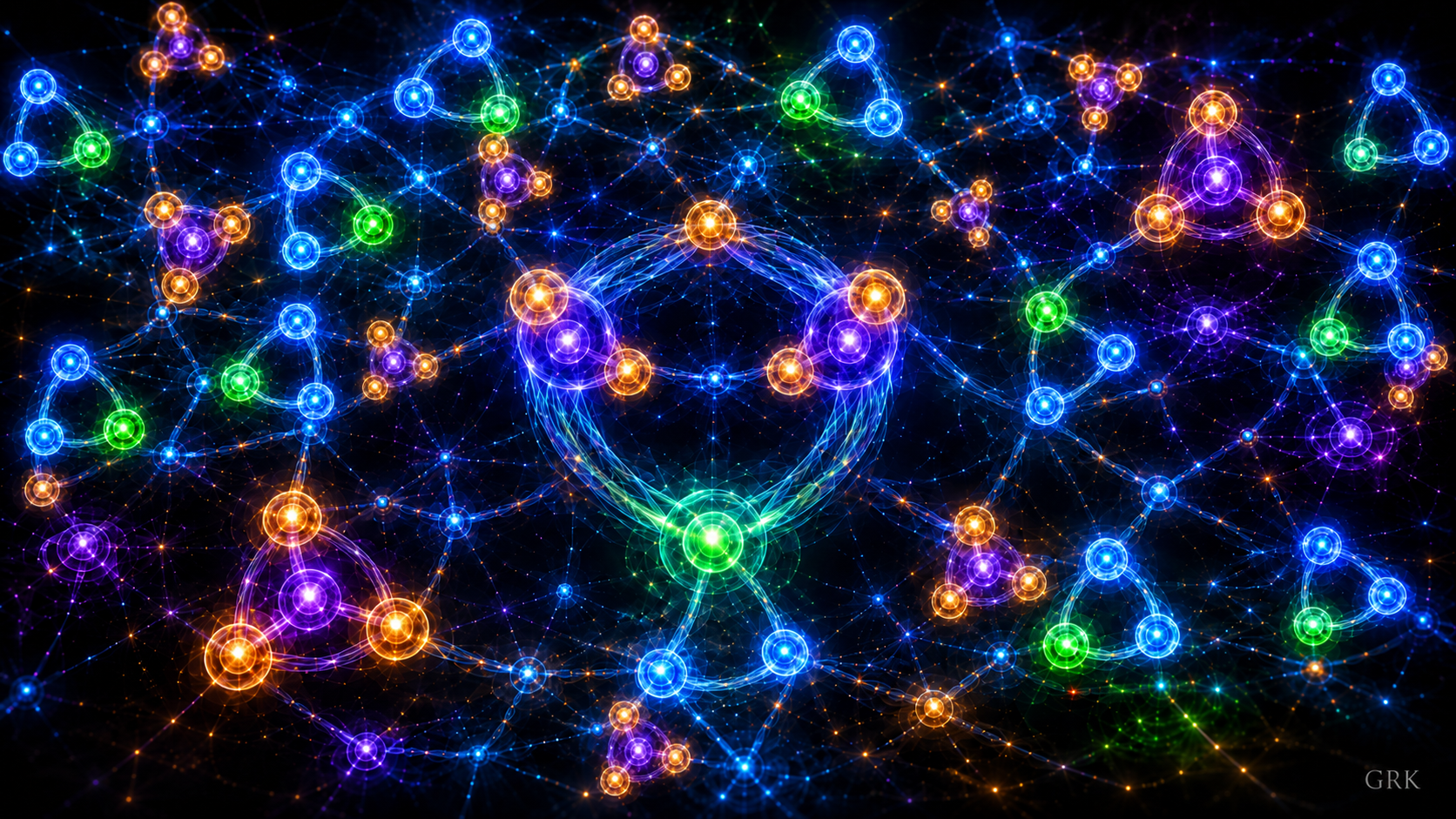
A second terminal closure used two Uniteons, one Deniteon, and three Zeteons. Two Uniteons and one Deniteon could first form the circulating UUD core called the Proteon, but UUD-first was not the only permitted assembly order. Zeteons could participate before the complete core existed, and the constituents could reorganize through other intermediate associations.
The Proteon defined the proton core but was not itself the completed proton. Proton identity was established only when all six CPPs reorganized into the admissible (UUDZZZ) geometry.
Within a Proteon, curvature remained in motion but did not yet fully close. The circulating phases exchanged curvature while releasing excess amplitude into nearby dormant corridors. These dormant channels absorbed the surplus and stabilized the surrounding environment, allowing the loop to persist across many recurrences.
Intermediate associations appeared wherever curvature interaction, phase compatibility, and local geometry permitted. Different sequences could terminate in the same completed particle, so the final inventory and closure geometry—not the chronological order of attachment—defined electron or proton identity.
Zeteon triads supplied the stabilizing boundary for both completed Regions. Because both closures required three Zeteons, electron and proton pathways drew on the same finite primordial Zeteon population. The timing and duration of intermediate associations could therefore affect closure timing and particle quantities without changing either particle's terminal identity.
Terminal (UUDZZZ) closure formed the proton, while terminal (EZZZ) closure formed the electron. These were the two stable compound CPP closures established during Combination. Additional Zeteons were not part of either defining inventory.
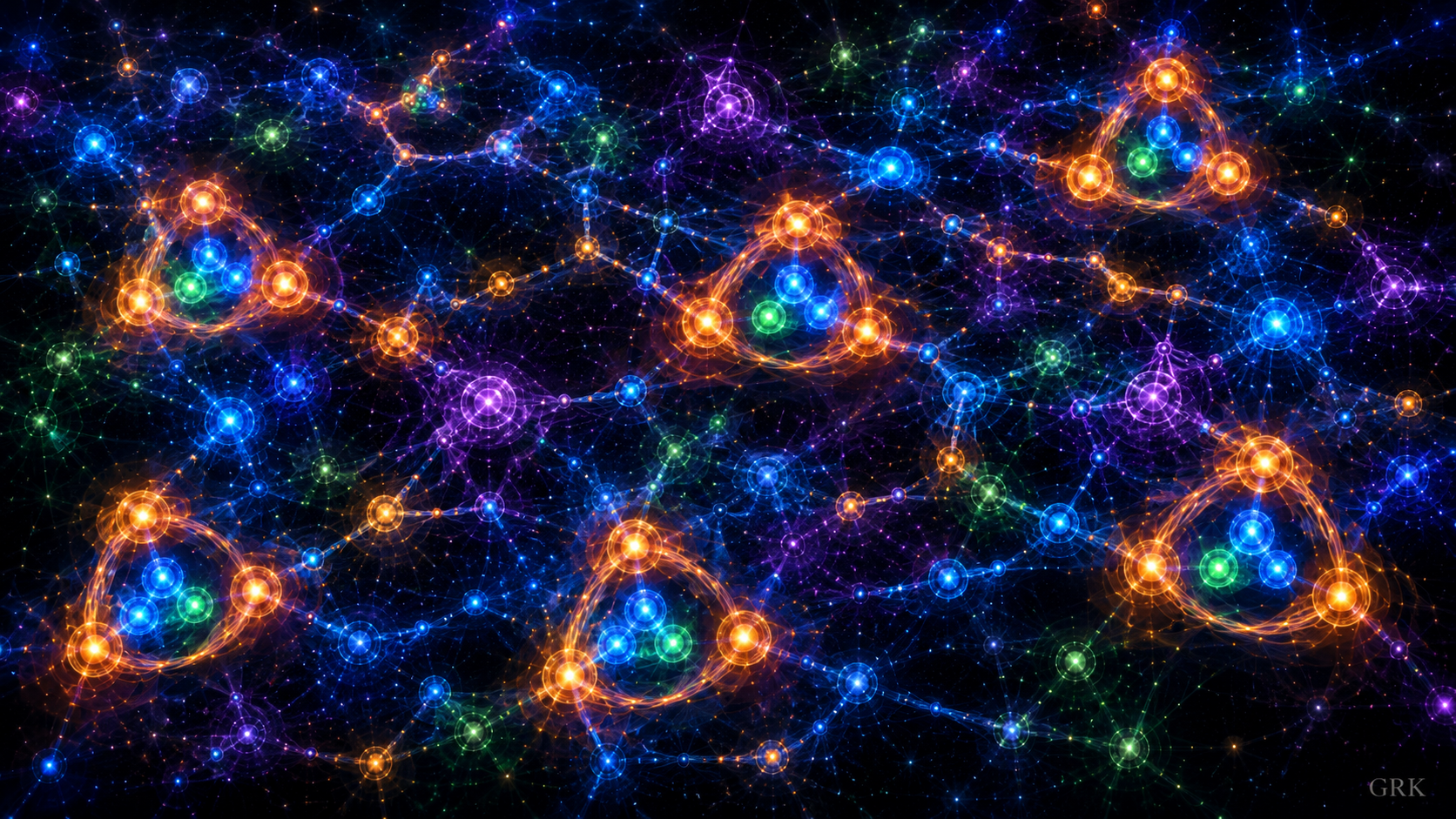
With these closures the lattice achieved its first stable compound curvature Regions. The stabilized Emeon and stabilized Proteon became the enduring electron and proton structures that would populate the universe.
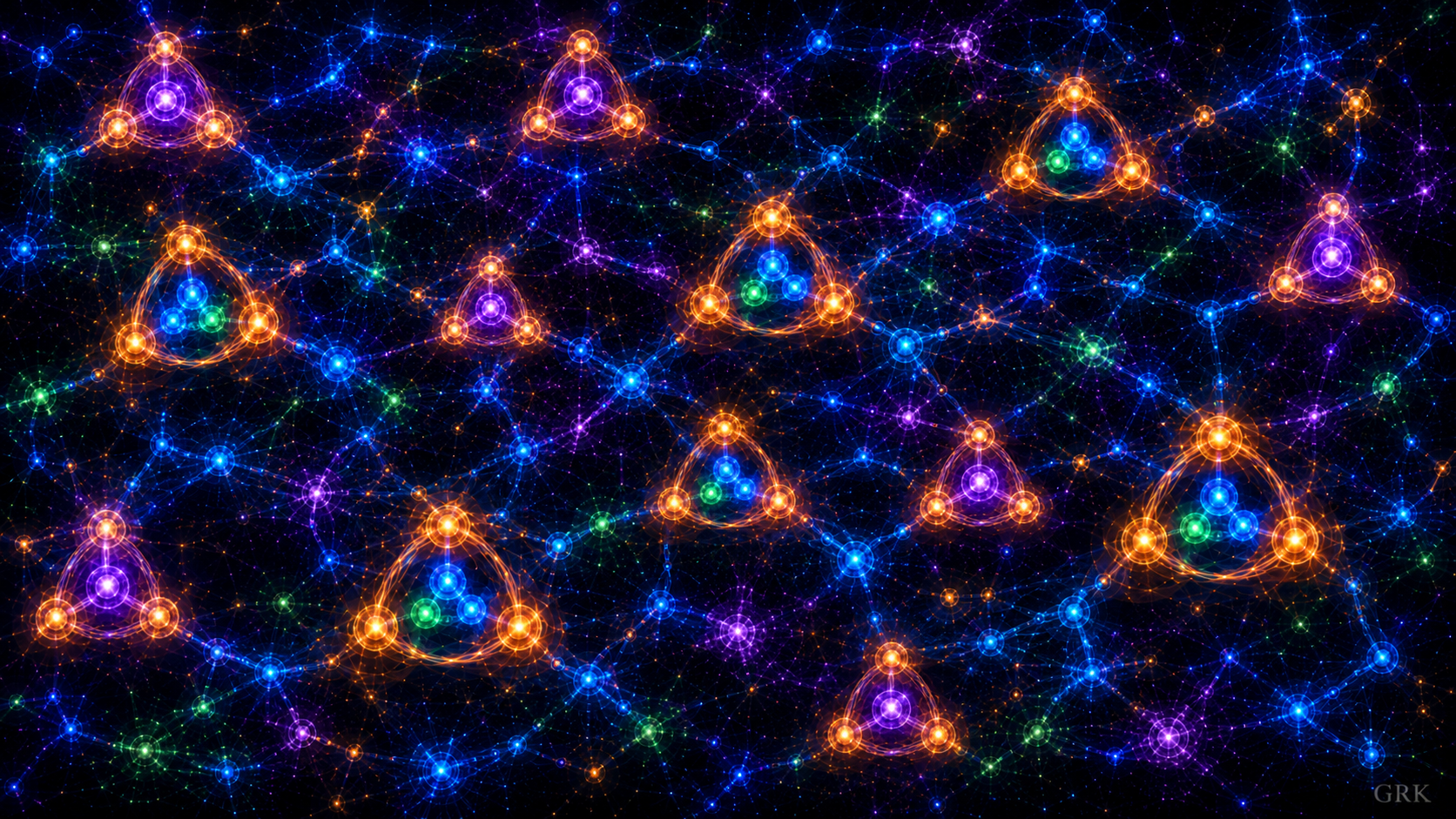
Simulation program · Chapter 4
Both Region families form repeatedly
Grid 96 · 10 seeds
420 proton Regions · 315.5 Emeon Regions
These median counts arose across ten runs without target-count gates, supporting the plausibility of the implemented combination rules producing both Region families. The simulator currently builds the UUD core before its Zeteon closure; that UUD-first ordering is an implementation assumption, not the only formation order established by the theory. The Chapter 4 handoff occurs at the first muon closure step, before terminal electron closure.
The continuum had crossed a fundamental threshold: recurring oscillations had become stable matter.
Summary
- Compatible phases combine into circulating structures that persist longer than isolated oscillations.
- Temporary CPP associations are not automatically stable Regions.
- Different formation sequences may terminate in the same completed particle.
- An Emeon becomes an electron only at terminal (EZZZ) closure.
- Two Uniteons and one Deniteon form the Proteon, the circulating UUD core of the proton.
- Proteons circulate curvature while releasing excess amplitude into nearby dormant corridors.
- Proton identity is established only at terminal (UUDZZZ) closure.
- Both particle classes require three Zeteons and therefore compete for a finite closure inventory.
- With electron and proton closure, recurring oscillations become the first stable matter Regions.
The inevitable
In many physical systems, motion that repeats long enough organizes into stable structures. Circulating flows form vortices in fluids, magnetic fields form closed loops in plasmas, and resonant systems settle into repeating patterns that persist over time.
The lattice followed the same principle. As coherence increased, circulating curvature could no longer disperse freely through the continuum. Where motion repeatedly returned upon itself, geometry favored confinement.
The neutral Zeteons supplied the stabilizing boundary. By gathering into triads around Emeon and Proteon structures, they anchored curvature reversal points and allowed local circulation to close into stable Regions.
From that closure emerged the first enduring structures of the lattice: the electron and the proton. Their appearance was not imposed from outside the system. It arose from the way coherent motion organizes itself when recurrence, curvature relief, and boundary stabilization act together.
Stable matter was therefore not an arbitrary feature of the universe. It was the expected outcome of coherence within the fabric.