Chapter 1 — Countless Fabrics
In our universe, the visible cosmos began about 13.8 billion years ago. This is when hydrogen first fused into helium without the help of stars, an event known as the Freeze-Out. But in the EOTU, that moment was not the true beginning. It was only the beginning of the universe we can observe.
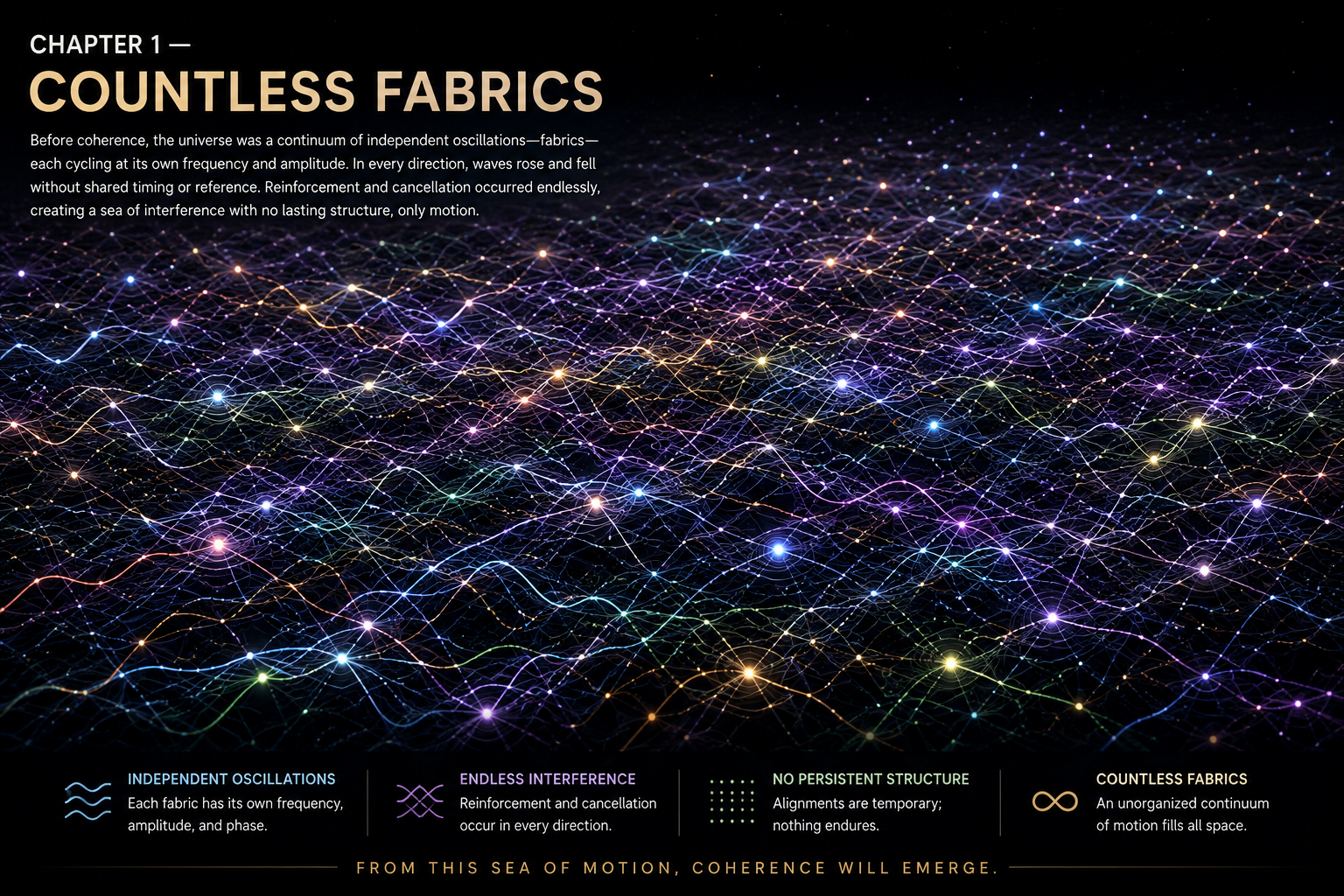
Before that, there were countless unorganized harmonic events — fabrics, for lack of a better term. Oscillating amplitudes filled every direction equally. No structure existed, only motion. Over time, some alignments lasted slightly longer than others. These lingering patterns were the first signs of order.
Each fabric oscillated at its own recurrence. Some cycled quickly, others slowly, and none shared a common reference. Reinforcement and cancellation occurred continuously. The continuum was dense with interference, a constant oscillation of amplitude across many phases.
Gradually, coherence accumulated. Certain alignments persisted and stabilized. Each new coherence reduced the overall contrast of amplitude, and the global mean began to settle. Variation organized itself without direction.
Even in this early balance, coherence remained statistical — an evolving mean rather than a fixed grid. Small residual shifts in phase and amplitude prevented the continuum from freezing, preserving the variability needed for structure to emerge.
Simulation program · Chapter 1
Coherent organization forms
Grid 96 · 10 seeds
0.9954 median final coherence
All ten runs formed the coherent lattice while conserving each run's total amplitude. This supports the computational plausibility of initially independent fabrics developing coherent organization. The coupling magnitudes are fitted, so the elapsed formation time is demonstrative rather than a physical prediction.
As fabric interactions accumulated, each oscillation participated through both its instantaneous displacement and its conjugate recurrence-rate response. Because the Fabric interaction treated these two quadratures equivalently, their lowest phase-selective contributions cancelled. Alignment could therefore persist without immediately forcing the continuum into two preferred orientations.
The first phase distinction that survived the nonlinear interaction repeated four times during a full cycle. Stable relationships consequently appeared at quarter-cycle separations. Fabrics settling into these relationships increasingly shared a common recurrence. From this growing coherence emerged the universal recurrence identified as the King Frequency, and the four stable phase families became the first Coherent Phase Packet eigenstates.
Summary
- Random motion resolves into four stable phase families.
- Stable phase relationships drive the emergence of a shared recurrence.
- The King Frequency defines the first universal coherent rhythm.
- Total amplitude remains conserved as coherence develops.
The inevitable
A sinusoidal oscillator carries two conjugate responses: its instantaneous displacement and the rate at which that displacement changes. These responses are separated by one quarter cycle but belong to the same oscillation.
In the EOTU Fabric, the interaction does not privilege one conjugate response over the other. Their lowest-order phase effects therefore cancel rather than selecting a preferred orientation. Nonlinear response leaves the next allowed phase-selective structure, which repeats four times per cycle.
The fourfold phase structure is therefore not produced by generic synchronization and is not inserted as a four-state rule. It emerges because quadrature-complete interaction removes the lower harmonic before coherence is established.