Equation of the Universe
A recurrence-and-geometry framework for cosmic structure
A public technical reference for an independently developed theoretical framework based on oscillatory coherence, phase alignment, curvature relaxation, and stable closure.
Current public status
EOTU is an active theoretical framework presented for technical review and independent reproduction. Version 3.46 is the latest complete internal baseline. Formal journal peer review is not claimed, and open scientific questions are recorded rather than treated as settled.
What EOTU Proposes
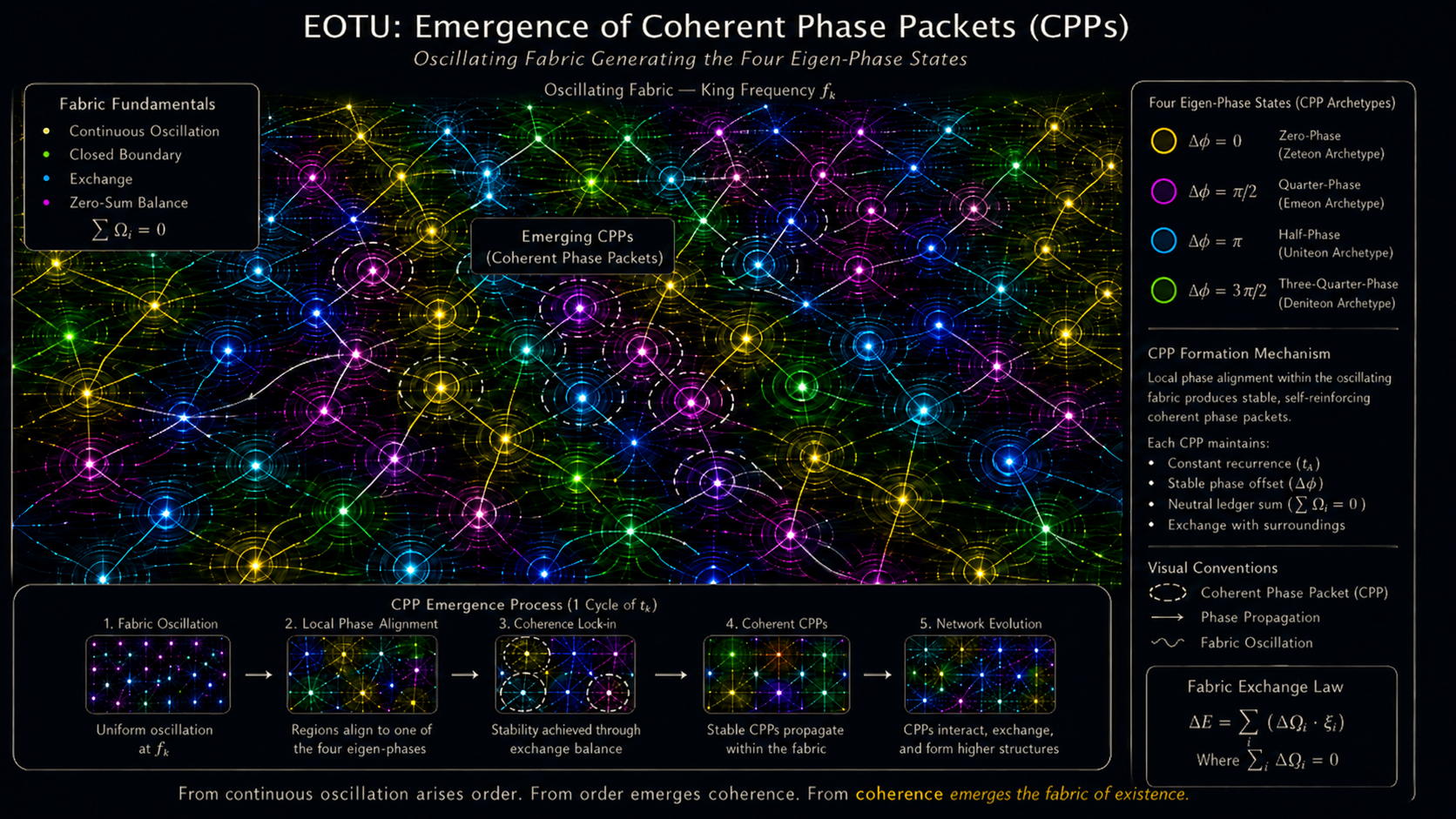
EOTU models the universe as an oscillatory fabric lattice. Within the framework, recurrence, phase relationships, and curvature organize the lattice into Coherent Phase Packets (CPPs). Stable closures of CPP structure are called Regions, and the framework uses these structures to describe matter, transport, and larger-scale curvature behavior.
This sequence is the organizing claim of the framework. The linked theory pages and supporting documents contain the definitions, derivations, adopted inputs, and comparisons used to evaluate it.
How to Evaluate the Work
A technical evaluation depends on keeping different kinds of statements separate. Throughout the public material, readers should distinguish the following:
Framework definitions and postulates
The terms, structural rules, and starting relationships that define the EOTU model.
Adopted calibrations and measured bridges
Observed values or unit mappings used to connect native EOTU quantities to measured units.
Derived results
Quantities produced from the stated framework rules and declared inputs.
Validation comparisons and open questions
Comparisons with observation, together with unresolved dependencies and tests still needed.
Some public derivations and status labels still require clarification. Those issues are part of the active review record; agreement with a measured value should not be treated as independent prediction until its full dependency path has been established.
Choose a Reading Path
New to EOTU
Begin with the terminology, scope, and map of the framework.
Follow the formation sequence
Read the proposed chronology from the earliest fabric state through Freeze-Out.
Inspect the rule set
Review the compact theory sequence, definitions, equations, and structural relationships.
Trace the quantitative record
Review the derived-values ledger and its distinctions among inputs, bridges, and comparisons.
Read the source documents
Access Tier 0 summaries, Tier 1 derivations, and Tier 2 calculation material.
Review or reproduce a claim
See the current review status and the kinds of technical feedback being requested.
Scientific Scope and Review
EOTU is presented as an alternative theoretical framework, not as established consensus physics. Its public claims should be judged by dimensional consistency, explicit dependencies, numerical reproducibility, comparison with observation, and the ability to survive independent criticism.
The site is being revised to make calibrations, unit bridges, derived quantities, validation comparisons, and unresolved questions easier to distinguish. Corrections and substantive changes are recorded on the Status and Revision Notes page.