Chapter 2 — First Coherence
As coherence developed, fabrics increasingly occupied the stable relative-phase states selected by the surviving fourth-order interaction after quadrature cancellation of the lower phase preference. These states were separated by quarter-cycle intervals and formed four persistent phase families. Once the shared recurrence stabilized, the four families became fixed relative to the King Frequency and formed the primordial CPP eigenstates.
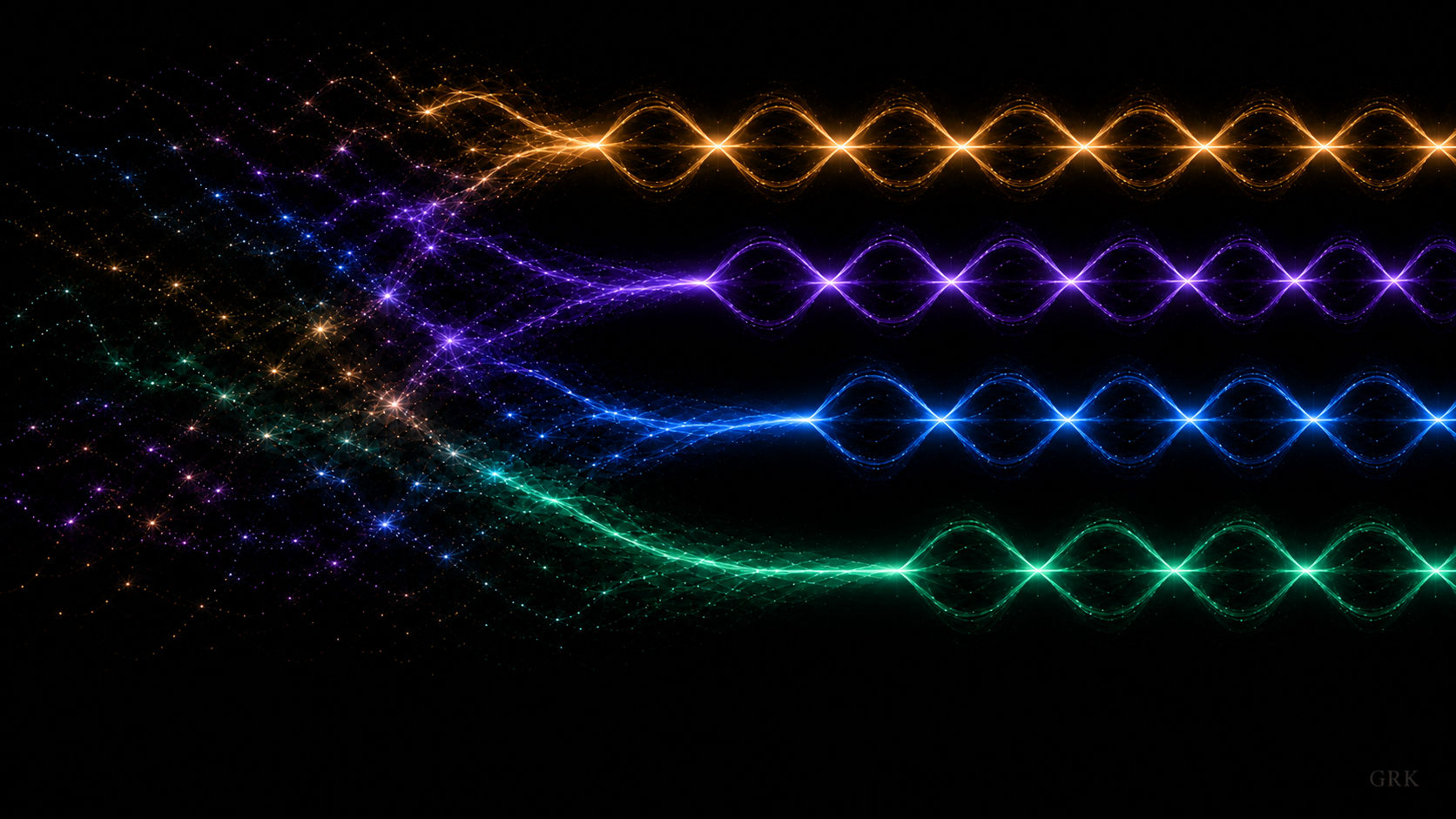
The first archetype to settle was the Zeteon, the neutral phase of the lattice. Positioned at the start of every cycle, phase zero, the Zeteon ensemble quietly leveled itself as the earliest coherent oscillations faded. Amplitudes redistributed until the lattice shared a common mean. This simple rebalancing established the first stable baseline of coherence — a fixed reference around which the other archetypes would later align. With the Zeteon balanced, the lattice acquired its first measure of stability.
Simulation program · Chapter 2
Zeteon-associated leveling appears
Grid 96 · 10 seeds
94.6% median reduction in amplitude variance
The exchange stage substantially leveled amplitude while conserving total amplitude and CPP populations. This supports the proposed stabilizing role of the Zeteon in the modeled lattice. The residual-shift term remains an explicit modeling assumption under review.
Only after this neutral foundation formed could the other archetypes begin to exchange and amplify. These interactions produced the active fabrics that would define later cycles. Among them, the Uniteon connected most efficiently. It coupled with the Emeon and the Deniteon, forming stabilized central domains.
Summary
- Formation of the primordials at four eigen phases.
- The lattice is filled only with these, except for a small number of imperfections called voids.
The inevitable
Even within the mathematics of the observable universe, many systems reduce to discrete eigen families similar to those in the aligned fabric. Mechanical resonators, optical cavities, and quantum orbitals all resolve into stable, self-reinforcing modes. In each, the allowed modes are fixed by boundary conditions and phase symmetry alone, with no added rule.
In materials and fluids, normal-mode patterns, reaction-diffusion lattices, and plasma oscillations display the same behavior. Stable systems converge toward a small set of persistent phase relationships.
The symmetry seen in the fabric is therefore not unique to this theory. It reflects a broader rule of nature: complex motion tends to organize itself into a small number of stable states.