Chapter 5 — The Fabric-Fusion Plateau (FFP)
After the first stable compound Regions appeared, the lattice entered a new stage of organization. Persistent proton Regions and Emeon-family closure states moved through the continuum as ionized structures rather than settled atoms. The Emeon-family population shared the same underlying Emeon-plus-three-Zeteon inventory while occupying terminal electron closure and non-terminal resolved closure states.
This stage was not yet the calm atomic universe that would exist after Freeze-Out. It was closer to a dense stellar-core environment at the edge of organization, where creation and destruction occurred together. Closed protons repeatedly encountered Emeon-family Regions in different closure states. A proton coupled to an appropriate non-terminal state, particularly (EZZ), could form a neutron composite, while other encounters separated or reconfigured the participating Regions. Early nucleon groupings could form briefly, then be disrupted again by collisions with neutrons, protons, and other high-exchange Region structures.
The Fabric-Fusion Plateau was therefore not a smooth assembly line. It was a chaotic ionized exchange stage in which Regions formed, decayed, collided, separated, recombined, and reconfigured. Neutrons were created and lost. Temporary nuclear groupings appeared and broke apart. Only configurations that relieved curvature while satisfying the surrounding geometry could persist long enough to influence the next stage of formation.
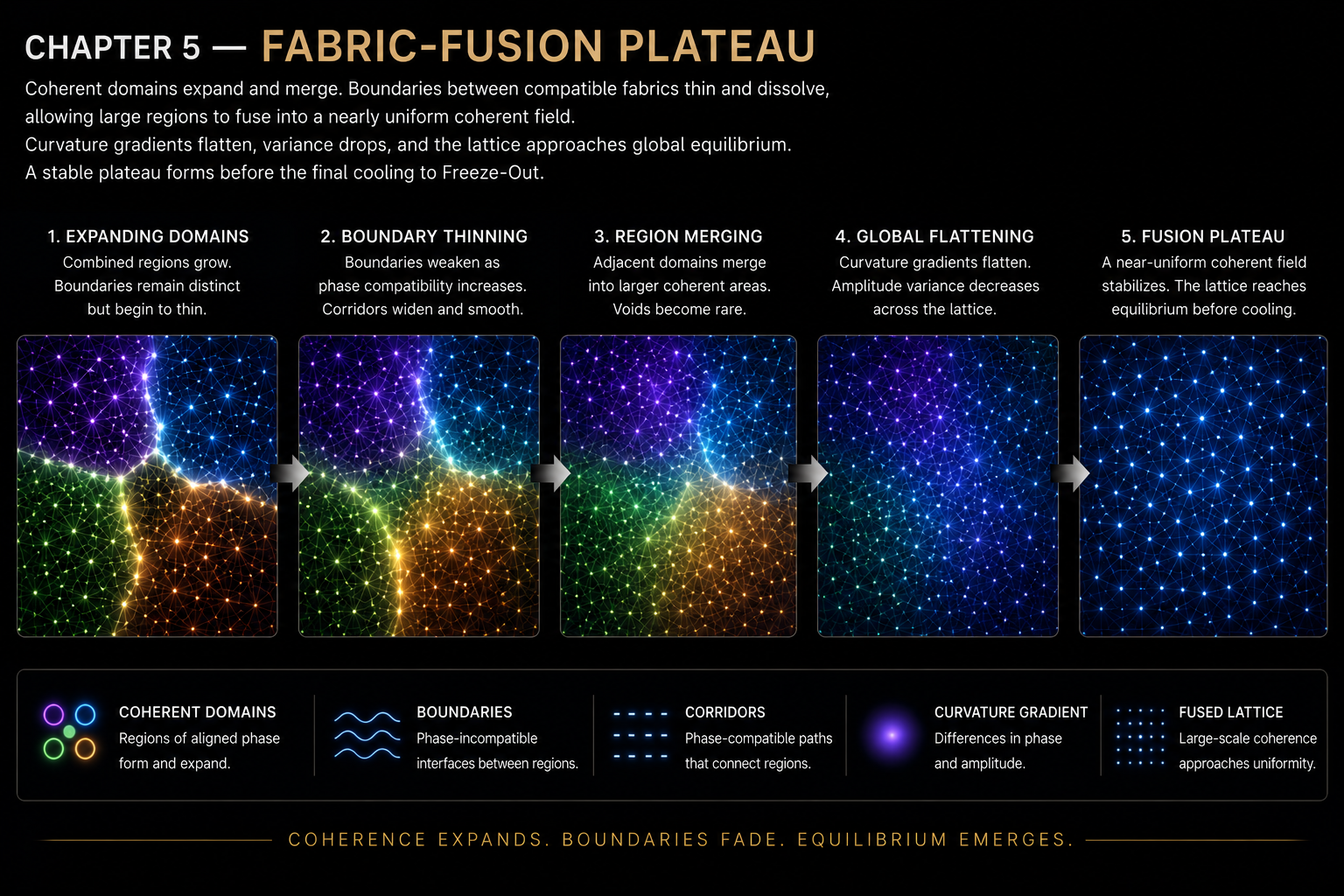
The dormant corridor network had already formed during earlier epochs and now acted as the transmission structure for curvature and phase redistribution. Active Regions exchanged curvature and phase through this network as they encountered one another, reorganized, separated, or settled into lower-curvature configurations.
The dominant process during this interval was no longer isolated CPP redistribution. Multi-cell Region coherence became the main pathway for reducing curvature contrast. Stable compound Regions repeatedly entered compatible, incompatible, and transient coupling states as the lattice continued seeking lower-curvature organization.
Proton–Emeon-family coupling existed during this epoch, but it did not define the settled proton–electron atomic structure of the post Freeze-Out universe. In the Fabric-Fusion Plateau, Emeon-family Regions could change closure state, couple to proton Regions, separate, reconfigure, decay, or participate in neutron-producing and fusion-producing encounters.
Where conditions permitted, a closed proton Region coupled to a non-terminal Emeon-family closure to form a neutron composite. The (EZZ) label identifies the closure state of the Emeon-plus-three-Zeteon structure; it does not indicate a reduced Zeteon inventory. The neutron was therefore not an independent primordial particle.
During these events, many recombination and reconfiguration pathways occurred across the ionized Region medium. Proton coupling to non-terminal Emeon-family closure, particularly (EZZ), could produce neutron composite Regions, while neutrino capture or phase-transfer exchange could provide additional neutron participation pathways. At this stage, transport was primarily unresolved curvature and phase redistribution through the dormant corridor network. Photon emission, as a resolved curvature packet, becomes the dominant description later, once post Freeze-Out atomic-scale transitions and stable corridor coupling are established.
As Region encounters multiplied, some configurations reached the conditions needed for the first helium closure. Helium formation represented a deeper curvature-relief pathway than temporary proton–electron coupling alone, because it produced the first fully closed multi-nucleon structure.
Helium closure did not occur because every encounter produced stable structure. It occurred because, within the chaotic exchange, a small subset of configurations satisfied the geometry needed to persist. Once those configurations formed, they provided a stronger curvature-relief channel than the transient couplings and broken groupings that surrounded them.
Light-Element Pathway Closures
The Fabric-Fusion Plateau includes a qualitative network of light-element pathway closures. In this usage, a pathway closure is a composite arrangement that can form during the exchange sequence. It does not imply that every arrangement is equally complete, equally durable, or assigned a derived primordial abundance. Helium-4 remains the first fully closed multi-nucleon Region in the EOTU formation sequence.
| Pathway closure | Qualitative formation role |
|---|---|
| Hydrogen (H-1) | The proton Region provides the one-nucleon hydrogen pathway during the exchange stage. Stable proton–electron corridor coupling and durable protium belong to the post Freeze-Out universe. |
| Deuterium (D) | A proton and a proton-coupled neutron composite enter a two-nucleon pathway closure. It can persist long enough to participate in further assembly or be disrupted by the exchange environment. |
| Tritium (H-3) | The deuterium pathway can acquire additional neutron participation, producing a neutron-rich three-nucleon closure pathway. |
| Helium-3 | The deuterium pathway can instead acquire additional proton participation, producing a proton-rich three-nucleon closure pathway that can continue toward helium-4. |
| Helium-4 | Two-proton and two-neutron participation produces the first complete multi-nucleon closure. Its persistence makes it the principal closed nuclear outcome of this stage. |
| Lithium-7 | A helium-4 closure can participate with a three-nucleon pathway to form a seven-nucleon closure pathway. Continued encounters can preserve it or redirect its components into other closed arrangements. |
This closure map is qualitative. It identifies the permitted sequence of structures without assigning reaction rates, production probabilities, temperature dependence, or primordial abundance predictions. The terms identify formation relationships only. Quantitative derivations of rates and resulting abundances remain outside the scope of this chapter.
As this exchange continued, the contrast between active Region curvature and the dormant-corridor mean decreased. The dormant field rose toward the active lattice mean, reducing the imbalance that had driven formation-scale restructuring.
The Fabric-Fusion Plateau therefore marks the interval in which the universe behaved as an ionized curvature-exchange medium. Its primary role was not to establish settled atomic structure, but to drive the lattice through neutron participation, repeated recombination, destructive collision, helium closure, and curvature relief.
Throughout the plateau, the main components of the later universe were present as stable or transient Region structures. Protons existed as stable closed Regions, while the Emeon family occupied terminal electron closure together with non-terminal closure states. Neutrons arose when an appropriate non-terminal state entered proton-coupled closure. Temporary nuclear groupings appeared and were often destroyed. Helium closure became available only when the required multi-nucleon geometry was satisfied.
When the remaining curvature contrast approached the threshold where further formation-scale restructuring could no longer continue, the plateau ended. The stage was set for the Freeze-Out.
Summary
- The Fabric-Fusion Plateau is an ionized Region-exchange stage, not a settled atomic stage.
- Closed proton Regions and Emeon-family closure states coexist within the high-exchange lattice.
- Neutrons arise when closed proton Regions couple to appropriate non-terminal Emeon-family closure states, particularly (EZZ).
- Creation and destruction occur together: couplings form, decay, collide, separate, recombine, and reconfigure.
- Temporary nucleon groupings can form briefly and then be disrupted by neutron, proton, and Region collisions.
- Neutrino capture and phase-transfer exchange provide additional pathways for neutron participation.
- Multi-cell Region coherence becomes the main pathway for curvature reduction.
- Helium closure emerges only from configurations that satisfy the required multi-nucleon geometry.
- H, D, H-3, He-3, He-4, and Li-7 are referenced as qualitative pathway closures.
- Only helium-4 is identified here as the first fully closed multi-nucleon Region.
- Reaction rates and resulting abundances are not assigned by this qualitative closure map.
- Photon emission becomes the dominant resolved transport description later, after post-FO atomic-scale coupling is established.
- The plateau ends when curvature contrast is sufficiently relieved for Freeze-Out to occur.
The inevitable
A dense ionized medium does not immediately settle into neutral atomic structure. Its components form, collide, break apart, recombine, and reconfigure until only the geometries capable of persistence remain.
The lattice followed this same progression. Once stable proton Regions and Emeon-family closure states existed, their interactions did not immediately create the calm proton–electron atomic separations of the later universe. Instead, they formed a high-exchange Region medium in which proton–Emeon-family coupling, neutron participation, neutrino exchange, destructive collision, and early fusion pathways occurred together.
Most early groupings were temporary. Some were disrupted by collisions before they could settle. Others decayed through phase exchange or separated back into their underlying Region components. But a small subset of configurations relieved curvature while satisfying the surrounding geometry.
Helium closure provided the first complete multi-nucleon relief channel. It was not the result of a smooth assembly sequence, but the persistent outcome that survived the chaotic exchange stage.
The Fabric-Fusion Plateau was therefore the required transition between particle closure and Freeze-Out. It carried the lattice from stable compound Regions through chaotic recombination toward the first closed nuclear structures.