CPP Baryonic Core and Halo Geometry
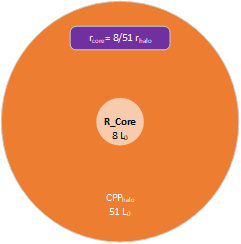
The best-fit cosmological baryon fraction provides a geometric constraint on the CPP curvature envelope. Using Planck 2018 base-\(\Lambda\)CDM values
the baryon fraction of total matter is
Using the fundamental lattice geometry,
where
- \(L_0 = 64\) — primitive lattice radial quantum
- \(8\) — core radial quantum (minimal curvature embedding radius)
- \(51\) — halo radial quantum
- \(k_{\mathrm{CPP}} \in \mathbb{Z}^{+}\) — lattice scale index
This ratio was adopted as the geometric constraint of the CPP envelope after noting that it closely matches the observed cosmological baryon fraction. Once introduced, the ratio provides closure for several independent relations in the lattice geometry.
Coherent Phase Packets (CPP) Structure
All measurable CPP physics is determined by the deviation from the dormant corridor mean. The dormant corridor mean amplitude \(\bar{A}\) therefore serves as the background reference state, while closure energies and interactions are governed by the deviation amplitude \(\Delta A\) and the geometry of the curvature envelope.
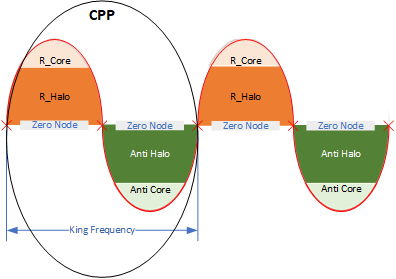
Each Coherent Phase Packet (CPP) occupies a single lattice cell while its curvature influence extends into the surrounding fabric according to its amplitude and phase relation to the King frequency. The packet oscillates about the dormant corridor mean amplitude \(\bar{A}\). The oscillation consists of two physically real curvature deviations:
- Positive lobe — curvature above the dormant corridor mean.
- Negative lobe — curvature below the dormant corridor mean.
These lobes are not time averages or mathematical constructs. They represent physically realizable closure states under appropriate stabilization conditions. Stabilization on the positive curvature lobe corresponds to matter states, while stabilization on the negative curvature lobe corresponds to antimatter states.
Summary
- The dormant corridor mean amplitude \(\bar{A}\) is the CPP background reference state.
- All measurable CPP physics is governed by the deviation amplitude \(\Delta A\) and the curvature envelope geometry.
- CPP oscillation consists of physically real positive and negative curvature lobes.
- Positive-lobe stabilization corresponds to matter states; negative-lobe stabilization corresponds to antimatter states.
- The native charge channel is the signed curvature deviation, while \(\mu_{\mathrm{cpp}}\) is the corresponding unsigned curvature inventory.
- The CPP envelope separates into baryonic core and halo regions with the fixed ratio \(r_c = \frac{8}{51} r_H\).
- The geometric ratio \(\frac{8}{51}\) aligns closely with the observed cosmological baryon fraction.
- The core and halo radii are given by \(r_c = 8k_{\mathrm{CPP}}L_0\) and \(r_H = 51k_{\mathrm{CPP}}L_0\).